
Marketing today feels more challenging than ever.
Advertising costs are rising. AI is changing the way businesses create content. Brands are fighting harder for visibility, attention, trust, and consistent sales in an increasingly crowded digital landscape.
As businesses continue navigating changing consumer behaviour, multiple platforms, growing competition, and constant pressure to stay visible, The Fine Print conducted a quick micro-survey to understand what business owners and leaders are truly concerned about when it comes to marketing in 2026.
The results revealed something interesting.
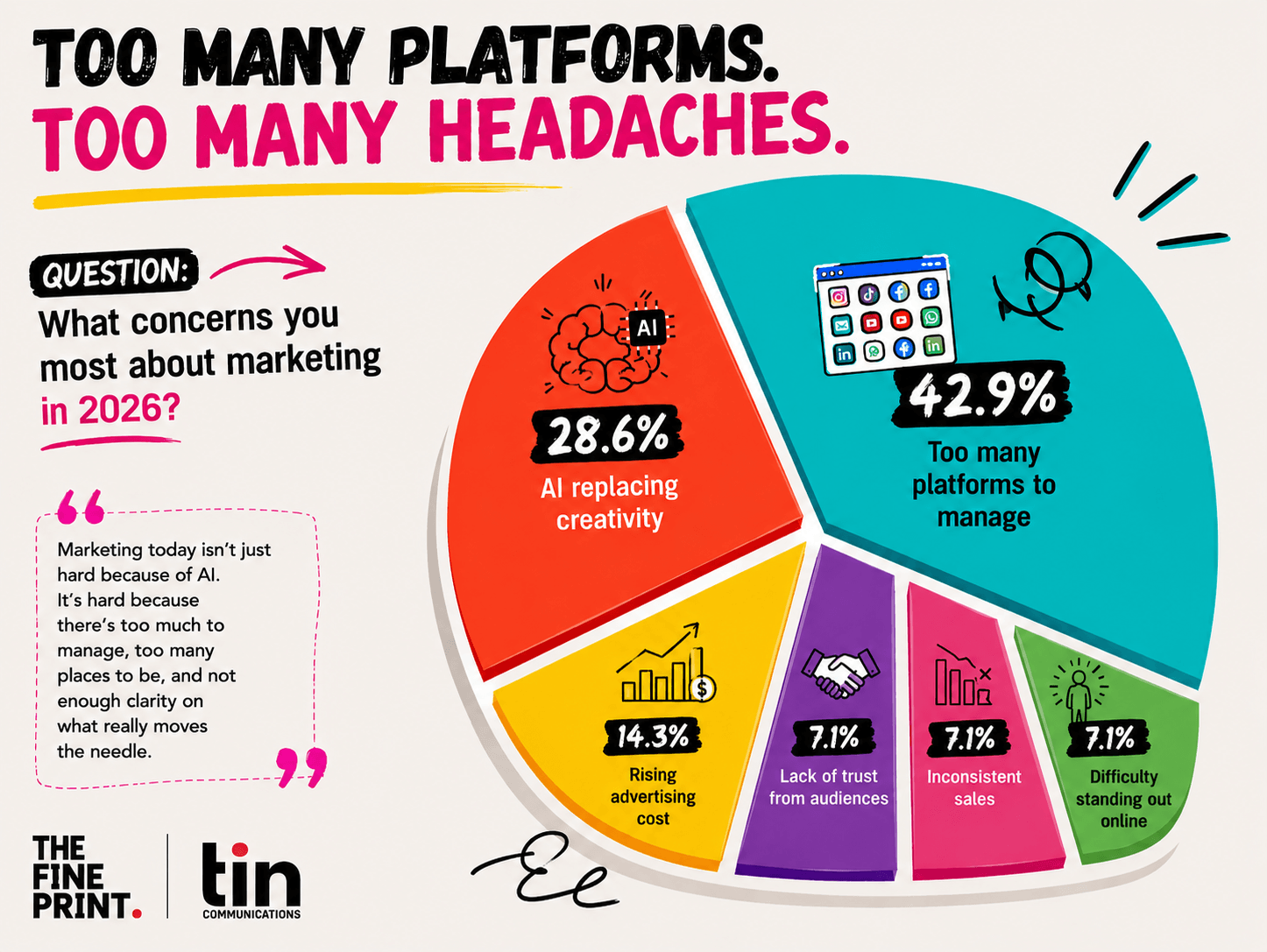
While AI continues dominating conversations across the business world, the biggest concern among respondents was not AI. It was managing multiple platforms.
Businesses Are Struggling with Platform Overload
A significant 42.9% of respondents identified “too many platforms to manage” as their biggest marketing concern moving into 2026. This placed it well ahead of concerns about AI replacing creativity (28.6%) and rising advertising costs (14.3%). Other concerns included inconsistent sales, difficulty standing out online, and declining audience trust.
Today’s businesses are expected to maintain visibility across Instagram, TikTok, LinkedIn, Facebook, Google, WhatsApp, email marketing, SEO, video platforms, and increasingly AI-powered channels all while ensuring consistency in branding, messaging, customer engagement, and conversion.
For many SMEs and lean teams, marketing is no longer just about creativity or visibility. It has become an operational challenge.
Businesses Want Structure, Not More Noise
What made the survey particularly interesting was the open-ended responses.
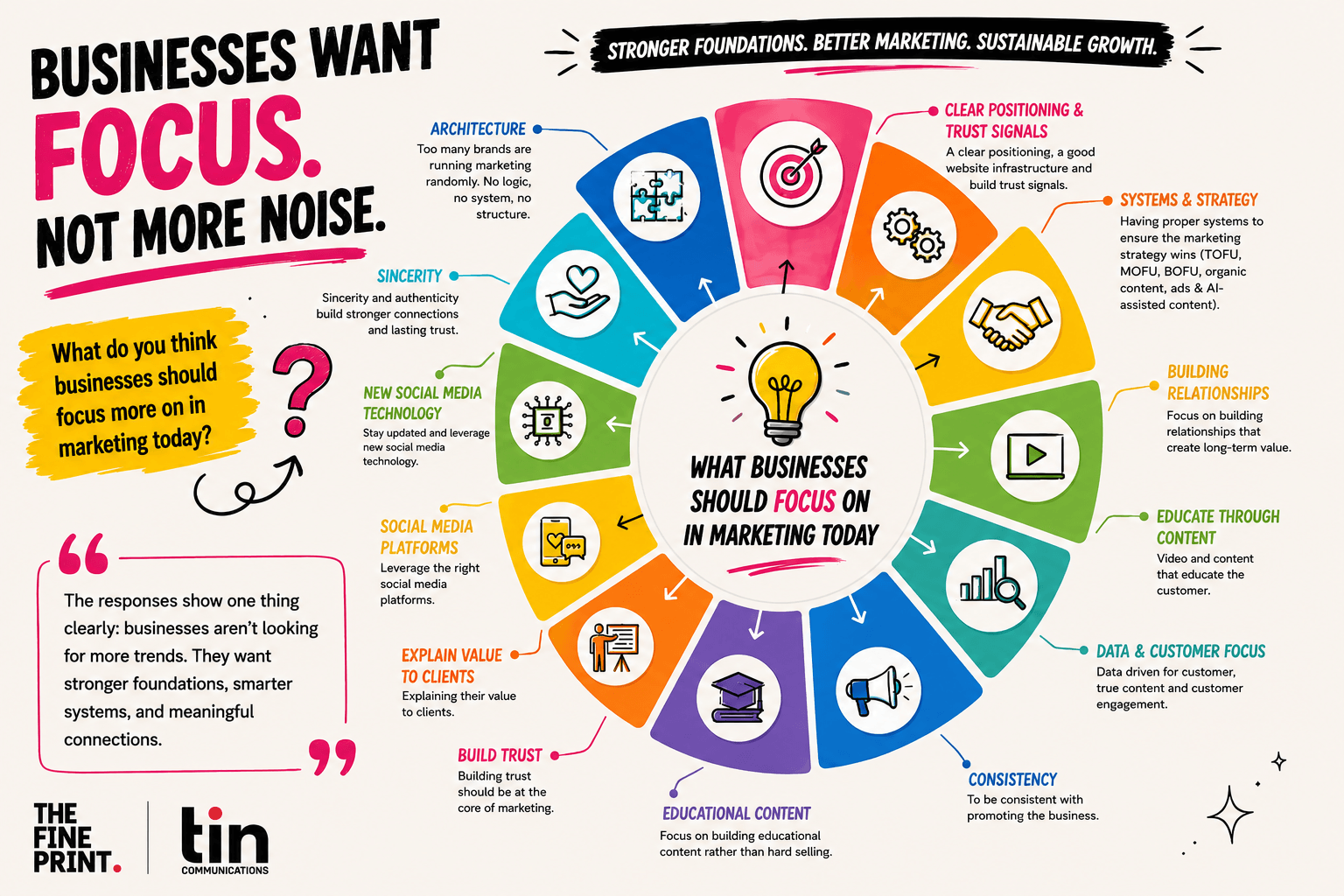
The recurring themes centred around clarity, systems, positioning, trust, consistency, and stronger marketing foundations.
One respondent shared that businesses should focus on “a clear positioning and good website infrastructure,” while another pointed towards the importance of “building relationships.”
Others highlighted the need for “having proper systems to ensure the marketing strategy works,” while several respondents stressed the importance of “being consistent with promoting the business” and “focusing on building educational content rather than hard selling.”
There was also a strong emphasis on trust and authenticity. One respondent simply answered with the word “sincerity,” while another highlighted the importance of “building trust.”
Several businesses also recognised the growing importance of data and customer understanding. Responses such as “data-driven for customers, true content, and customer understanding” and “explaining their value to clients” reflected a desire for marketing that feels more intentional and meaningful rather than reactive.
One response particularly stood out:
“Educating the market and touching on their pain points.”
Quietly, this reflects a shift happening across the business landscape. Businesses are beginning to realise that visibility without structure eventually creates exhaustion. Marketing without positioning creates noise. Content without systems becomes difficult to sustain.
AI Is Changing Marketing, But Trust Still Matters
Even concerns surrounding AI appear less rooted in fear and more connected to uncertainty. AI may be accelerating content creation, but it is also increasing digital clutter. Businesses are now competing against endless streams of automated content across every platform imaginable.
In that environment, trust becomes even more valuable.
Interestingly, while AI replacing creativity ranked as the second-highest concern, the survey responses themselves revealed that businesses are not necessarily rejecting technology. Instead, many appear to be searching for balance — leveraging technology while maintaining authenticity, trust, and meaningful customer engagement.
The Real Marketing Challenge of 2026
Perhaps that is the bigger story behind this survey.
The findings suggest that businesses may need to stop chasing every platform, every trend, and every new marketing tactic simply because competitors are doing it. Not every business needs to be everywhere at once.
Sometimes, stronger marketing comes from doing fewer things with greater clarity and consistency.
The answer may not be “more marketing.”
It may be fewer platforms, clearer positioning, stronger systems, better customer understanding, and marketing efforts that businesses can realistically sustain over the long term without burning out their teams or confusing their audiences.