

Conversation With : Khai Helmi, Founder of Lumoguide
“In a world where AI can make almost anyone look impressive, trust may become our most valuable professional asset.”
For decades, careers have been built around qualifications, job titles and carefully crafted résumés. Yet as artificial intelligence reshapes the workplace and career paths become increasingly fluid, are these traditional markers still enough?
For Khai Helmi, Founder of Lumoguide, the answer lies elsewhere. He believes that the most valuable asset professionals carry is not their résumé, but the reputation they build through years of working with others.
In this edition of Conversation With, The Fine Print speaks to Khai about entrepreneurship, the future of work and why authentic human trust may become the defining currency of tomorrow’s professional landscape.
From Corporate Leadership to Entrepreneurship
Before founding Lumoguide, Khai spent much of his career in media, marketing and business growth, holding leadership roles across agencies, brands and regional organisations. His work centred on helping businesses scale, but entrepreneurship was never far from his mind.
“I’ve always believed I would eventually become a founder,” he shares. “Over the years, I’ve built businesses before. Some worked, some didn’t, but every experience taught me something valuable.”
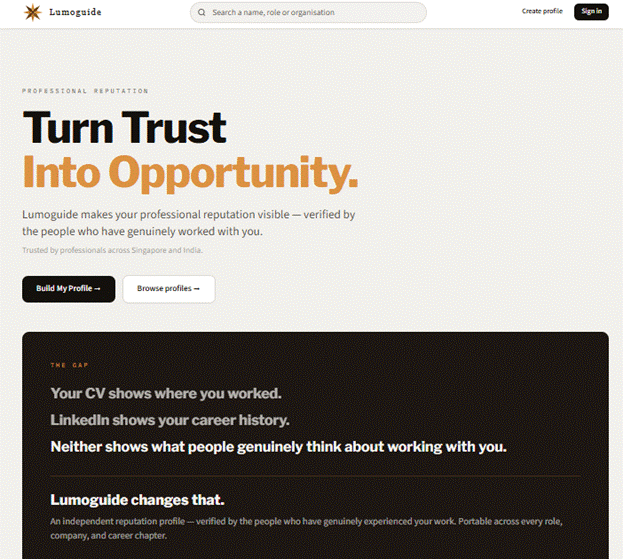
Lumoguide, he says, is simply the next chapter in that journey. What began as an idea has evolved into something far more significant – a platform designed to help professionals make one of their most valuable yet invisible assets visible: their reputation.
More Than a Résumé
The inspiration behind Lumoguide came from a question that Khai found difficult to ignore.
“What if your biggest asset was never your résumé, but your reputation?”
The idea emerged as he observed the realities of today’s workforce. Professionals spend years building trust with clients, employers and colleagues, only to find that during periods of retrenchment or career transition, those years of credibility are often reduced to a single résumé competing with hundreds of others.
“That genuinely bothered me,” he says. “People invest years earning trust, yet when they look for their next opportunity, much of that trust becomes invisible.”
For Khai, the issue isn’t whether qualifications matter—they do. The challenge is that they rarely tell the full story.
Reputation in the Age of AI
As artificial intelligence continues to transform recruitment, job applications and personal branding, Khai believes genuine reputation will become even more valuable.
“AI will make it easier for almost anyone to produce an excellent résumé, optimise a LinkedIn profile or prepare for interviews,” he explains. “If everyone appears exceptional on paper, how do employers distinguish one candidate from another?”
His answer is simple: trust.
“In a world where information becomes easier to manufacture, authenticity becomes more valuable.”
It is this conviction that underpins Lumoguide’s mission is to help professionals showcase the trust they have earned through real working relationships rather than relying solely on self-declared achievements.
Redefining Personal Branding
Ask Khai about personal branding, and his perspective differs from the conventional narrative.
“Many people think personal branding is about followers, visibility or creating the perfect online image,” he says. “I don’t see it that way.”
Instead, he offers a much simpler definition.
“What do people genuinely think about you when you’re not in the room?”
For him, the strongest personal brands are not built through self-promotion but through consistent experiences shared by clients, colleagues, managers and collaborators.
Without trust, he believes, personal branding risks becoming little more than performance.
Beyond LinkedIn
While LinkedIn has transformed professional networking, Khai sees Lumoguide addressing a different challenge.
“LinkedIn tells people who you are,” he explains. “Lumoguide shows what people genuinely think about working with you.”
Rather than functioning as another testimonial platform, Lumoguide structures recognition around real professional relationships. Contributors identify whether they know someone as a client, manager, mentor, colleague or collaborator, helping create context around every recognition received.
“One endorsement means very little,” he says. “But when recognition comes consistently from different people across different relationships over time, meaningful patterns begin to emerge.”
Protecting authenticity, he adds, is fundamental to the platform’s purpose.
“The moment trust breaks, the platform loses its reason to exist.”
Building a Reputation That Lasts
Looking ahead, Khai hopes employers will begin evaluating talent through a broader lens.
Degrees, experience and technical skills will always matter, he says. Yet they do not answer one of the most important questions.
“What was it actually like working with this person?”
Were they dependable? Did they consistently create value? Would colleagues willingly work with them again?
For professionals, his advice is straightforward.
“Don’t wait until career uncertainty forces you to realise your reputation matters.”
Every conversation, every project and every professional relationship quietly shapes opportunities that may only appear years later.
“Build trust intentionally,” he says. “Because reputation compounds.”

Looking Ahead
As workplaces continue evolving and careers become increasingly non-linear, Khai believes the future belongs to professionals who invest not only in their technical capabilities but also in the trust they build over time.
Perhaps that is Lumoguide’s biggest idea.
Not that reputation replaces experience or qualifications—but that it gives meaning to them.
Because while careers may change, titles may come and go, and technology will continue advancing, the confidence others place in us remains one of the few professional assets that can continue opening doors throughout a lifetime.
Learn more about Lumoguide at https://lumoguide.co or connect with Khai Helmi on LinkedIn to follow the platform’s journey.